Seeing a pangolin in the wild has been on our bucket list for a long time.
So when we were planning our trip to Namibia, we knew we have to book a pangolin tracking experience at Okonjima Nature Reserve.
After finishing the leopard tracking, we were driven back to have dinner. Our guide told us before we went in, that the timing to go and see the pangolins was dependent on the time the pangolins came out of their burrow. If they hadn’t come out by midnight, we would be unable to see them.
As we were about to eat our dessert, our guide came over to let us know that one of the pangolins had come out of its burrow. We quickly ate our dessert and jumped in the safari truck with our guide.
We drove out into the game reserve in the pitch black for about 20 minutes before we came across the rangers. We could see their red lights as we approached.
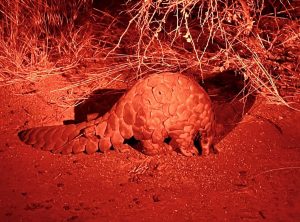
Our guide told us to be very quiet and we were given a head lamp. We started walking from the vehicle into the dark and as we got close, our guide told us to change the light on our headlamp to red so not to stun or disturb the pangolin. We crept slow towards to the red light and met up with the rangers.
It was then that we noticed movement on the ground. It was the pangolin! It was quietly creeping around, foraging for ants. It was amazing to watch.
We didn’t realise that pangolins walk on their back legs, using their tail for balance. The pangolin foraged, not paying any attention to us. The ranger told us to move only when the pangolin moved.
After watching the pangolin for about 20 minutes, it was time to go. It was special to be able to spend time with this elusive creature.
What are pangolins?
Pangolins, often called scaly anteaters are shy and elusive, only coming out at night. These mammals are covered with scales made of keratin that are so strong, even leopards can’t bite through it.
What Type of Pangolins are found at Okonjima Nature Reserve?
The pangolins found at Okonjima are Temminck’s ground pangolin (Smutsia temminckii) or ground pangolin.
What do pangolins eat?
Pangolins eat ants and termites using their long tongue to scoop them up. Pangolins do not have teeth.
Why are pangolins so rare?
Pangolins are the most trafficked mammal in the world with animals taken from Africa and sold to the Asian market. Their scales are used for Chinese medicine and their meat is considered a delicacy. Protecting these amazing creatures in vital to their long term survival.
How much does it cost to do pangolin tracking?
Pangolin tracking cost us $2660 NAD per person, which is about $235 per person AUD. In my view, it is definitely worth it. The pangolins are tracked by rangers to let you know when they have come out of their burrows. You are also taken out in a guide in private game drive vehicle in the night – so your fee covers this cost. Money from your fee goes towards conservation of pangolins.