If pristine lakes, ancient rainforests, and beach drives are on your bucket list—then this 4WD adventure is for you.
K’gari (formerly Fraser Island) is the world’s largest sand island and one of Australia’s most iconic off-road adventures. Recently, we tackled K’gari in four unforgettable days—and here’s exactly how we did it.
Day 1 - Lake McKenzie and Central Station
We picked up our 4WD on the mainland and caught the barge from Inskip Point, the southern access to K’gari. Once we landed, the real adventure began.
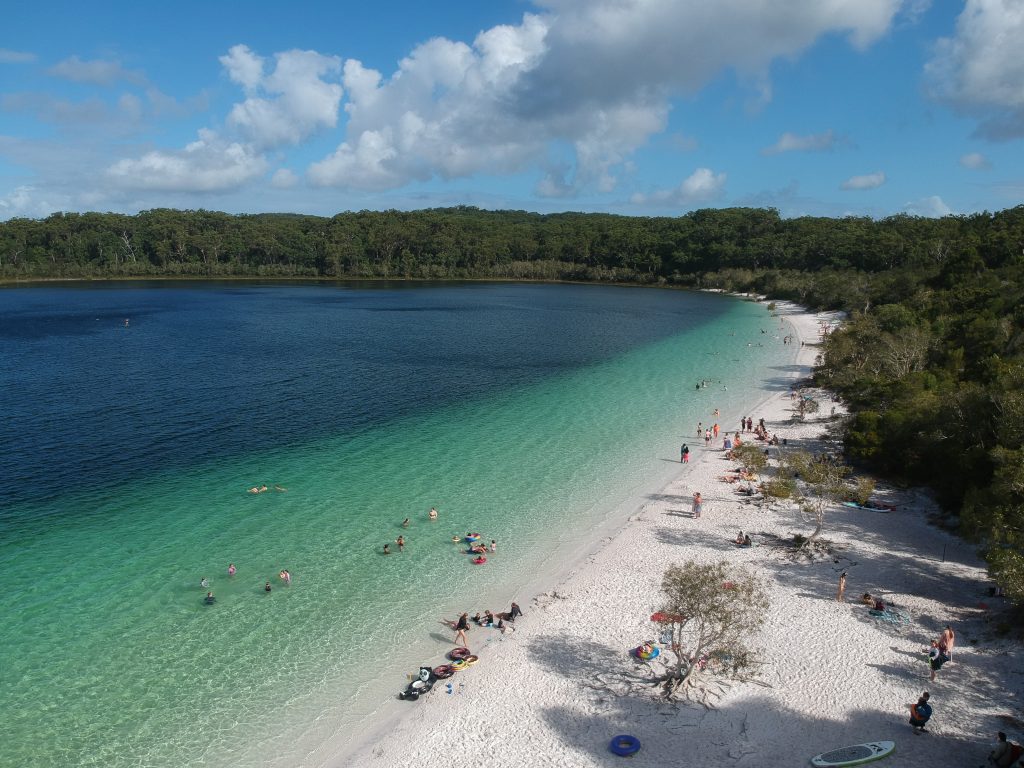
First stop: Lake McKenzie, a stunning lake with impossibly blue water and soft white silica sand. It’s one of K’gari’s crown jewels and perfect for a refreshing swim.
Lake McKenzie (or Boorangoora, as it’s known to the Butchulla People) is a perched lake — meaning it sits above the water table and is filled only by rainwater. No streams flow in or out, and there’s no groundwater seeping in. It’s completely self-contained and pure.
That means:
Crystal-clear water so pure that it’s almost acidic — nothing lives in it except a few microorganisms.
Powder-white silica sand so fine and soft, it squeaks under your feet (and is said to make your skin feel silky smooth).
Blindingly blue hues that shift from turquoise to deep sapphire depending on the sun and sky.
It’s nature’s infinity pool — and you don’t need a luxury resort to enjoy it.
Lake McKenzie is only accessible by 4WD, about a 30-minute drive inland from Eurong on rough, sandy tracks. The roads can be bumpy and narrow, but totally worth the journey.
💡 Tip: Go early in the morning or late in the afternoon to avoid the midday crowds that come with day tours.
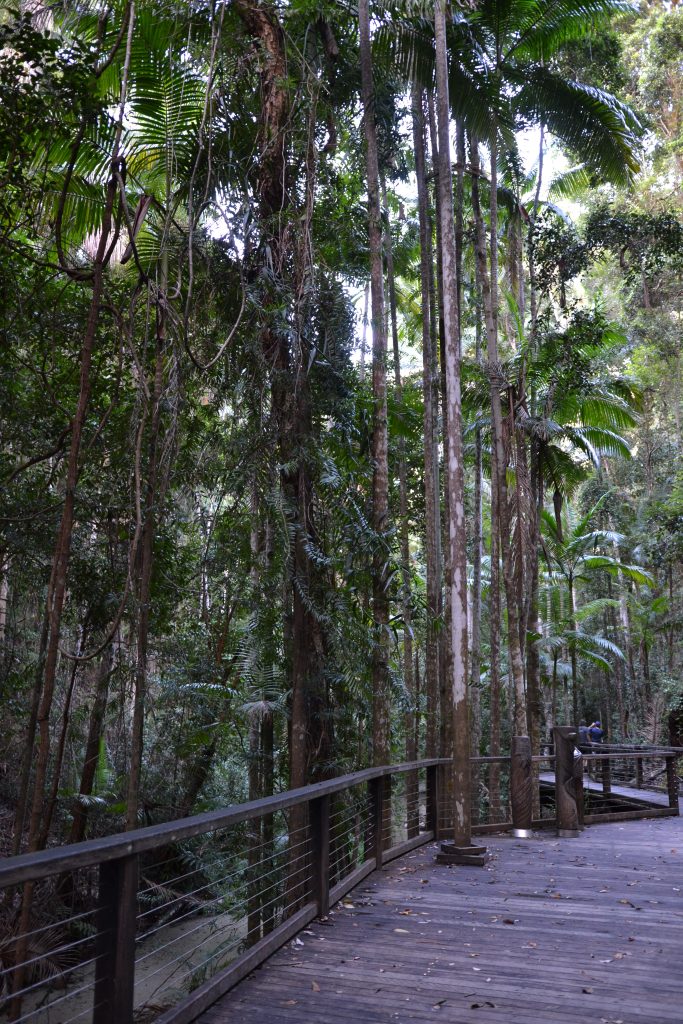
Next, we headed to Central Station, a lush rainforest oasis that once served as a logging camp.
This tranquil area is the perfect spot to stretch your legs, breathe in crisp rainforest air, and experience the ancient beauty of the world’s largest sand island in a completely different way.
The towering satinay trees and crystal-clear Wanggoolba Creek made us feel like we were deep in a tropical jungle.
We spent the night at Eurong, a small resort village on the eastern beach—a great base to explore the island.
Day 2 - Eli Creek, Champagne Pools and SS Maheno Wreck
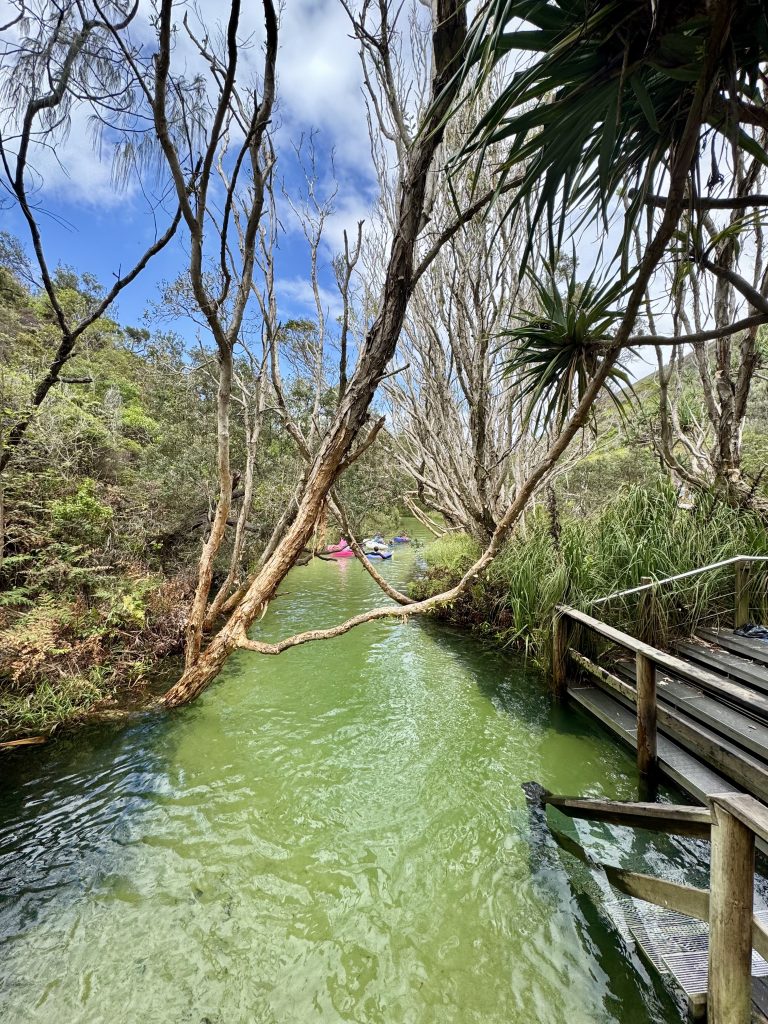
We started the day at Eli Creek. This crystal-clear freshwater stream isn’t just one of the most popular stops along 75 Mile Beach — it’s also one of the most relaxing, family-friendly, and unforgettable experiences the island has to offer.
Things to do at Eli Creek
1. Float the Creek
Bring a pool noodle, an inflatable tube, or just your swimsuit. Enter the creek at the wooden boardwalk and let the current drift you downstream. It’s a short, serene ride — but most people go again and again!
2. Picnic by the Water
There’s a wide, grassy area and plenty of space to set up a picnic or relax with a snack. Many 4WD travelers bring folding chairs and settle in for a leisurely lunch.
3. Walk the Boardwalk
A wooden boardwalk runs alongside the upper part of the creek, offering a lovely short stroll and a great view of the surrounding rainforest.
4. Take a Dip
Even if floating isn’t your thing, the creek is perfect for wading, paddling, or simply cooling off your feet after a dusty drive down the beach
Champagne Pools
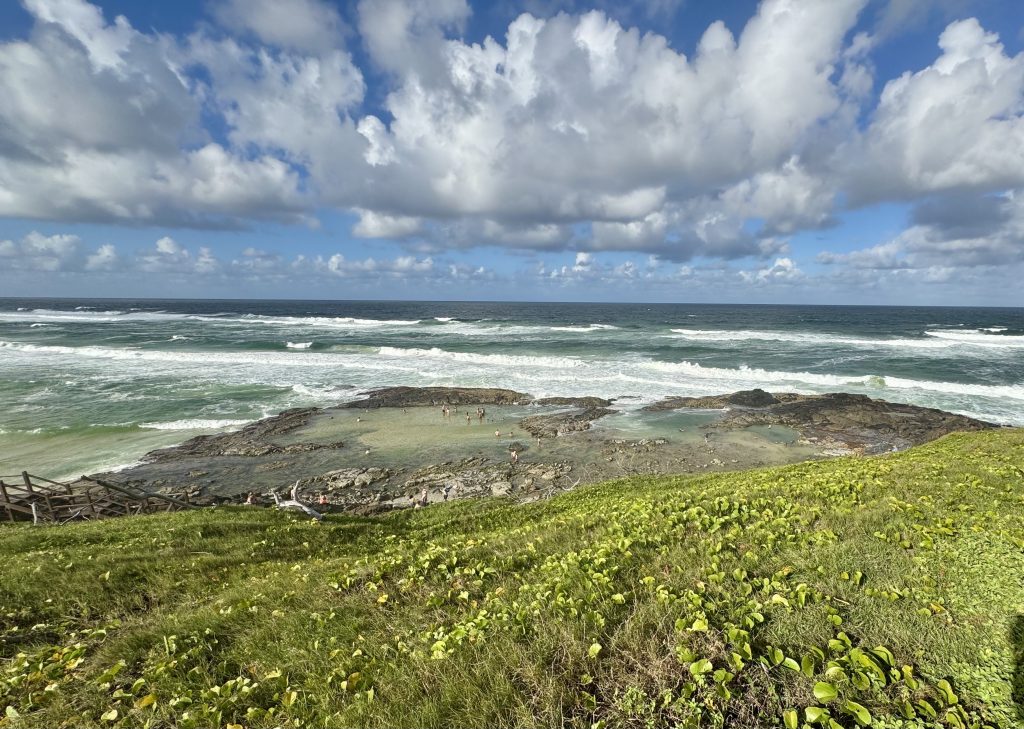
From there, we headed north to the Champagne Pools, named for the bubbly saltwater that crashes over the rocks into shallow pools.
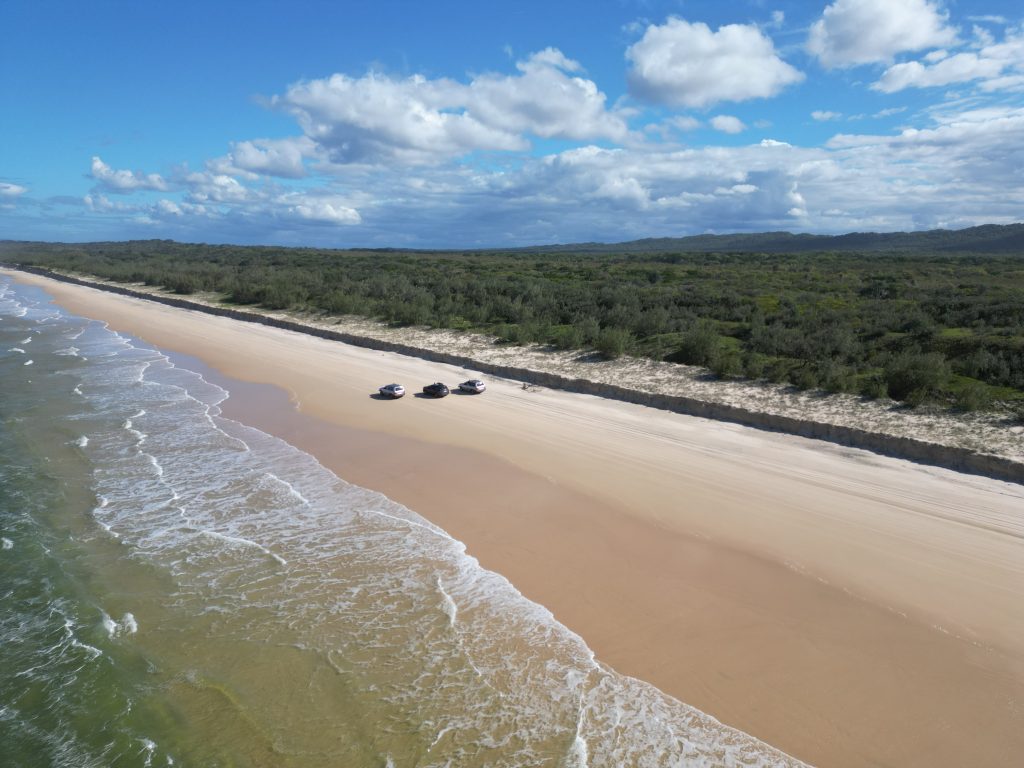
To reach the Champagne Pools, you’ll need a 4WD and good timing with the tides. Driving up 75 Mile Beach, you’ll pass iconic stops like Eli Creek, the Maheno Shipwreck, and Indian Head before arriving at the Champagne Pools.
This is one of the few places on K’gari where you can safely swim in ocean water.
A Word About Safety
Although the pools themselves are safe for swimming, it’s important to be aware:
Stay within the pools. Don’t venture too close to the outer edges—sneaky waves can crash in with force.
Never turn your back on the ocean when near the rocks.
Bring water, a hat, and sunscreen—there’s no shade, and the sun can be intense.
SS Maheno Wreck

As we cruised back from Champagne Pools along 75 Mile Beach on the eastern shore of K’gari, a rusting skeleton slowly emerges from the sand—the haunting remains of the SS Maheno. Time, tide, and salt have battered her, but this wreck tells a story of luxury, war, and one very unexpected storm.
In 1935, after working as a hospital ship during World War 1, she was sold for scrap to a Japanese company. She was being towed from Sydney to Japan by a tugboat—without engines, power, or a crew onboard—when a cyclone hit off the coast of Queensland.
The tow line snapped in the storm, and the Maheno drifted helplessly before beaching herself on the sands of K’gari’s eastern shore.
Efforts to re-float her failed, and eventually she was left where she lay—abandoned, rusting, and slowly claimed by the island.
The Maheno is more than just a photo stop. She’s one of K’gari’s most iconic landmarks and a powerful reminder of the island’s wild beauty and unpredictable nature.
Day 3: Lake Wabby
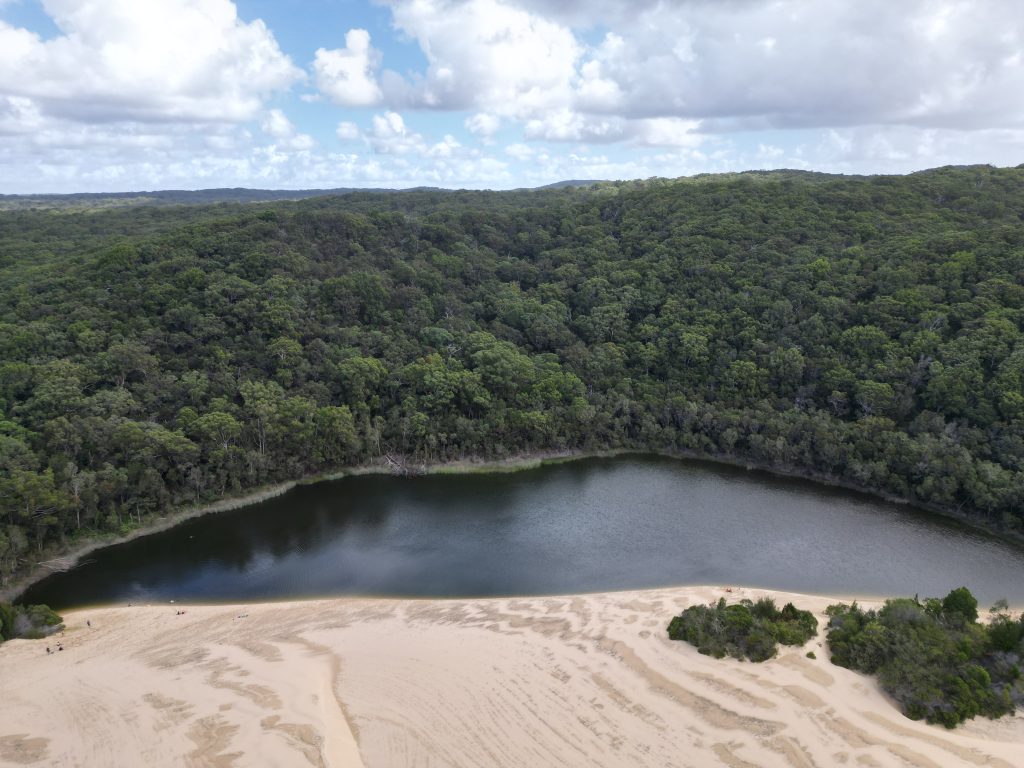
Tucked behind towering dunes and surrounded by eucalypt forest lies one of K’gari’s best-kept secrets — Lake Wabby. If you’re up for a bit of a hike and a big reward, this lake should definitely be on your ultimate bucket list.
It’s the deepest lake on K’gari, plunging to around 12 metres. What makes it unique is that it’s a barrage lake — formed where a natural spring is blocked by a migrating sand dune.
But what steals the show is the massive Hammerstone Sand Blow, a vast desert-like expanse that stretches right up to the lake’s edge. The contrast of golden sands against deep green water is absolutely stunning — and completely different from any other lake on the island.
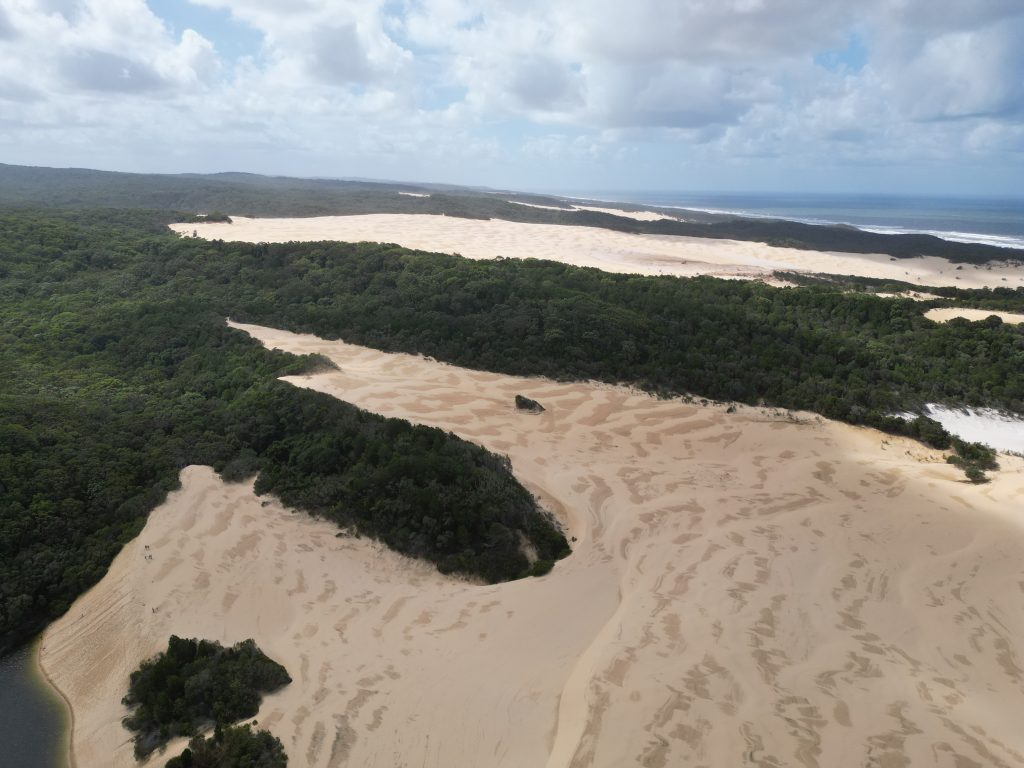
Lake Wabby is disappearing — slowly but surely. The Hammerstone Sand Blow is shifting steadily, and eventually, it will engulf the entire lake.
This makes visiting Lake Wabby all the more special. It’s a natural wonder on borrowed time, so if it’s on your bucket list, don’t wait too long to tick it off!
The Hike Into Lake Wabby
Lake Wabby is only accessible on foot, so be prepared for a moderate hike — about 2.5km one way from the car park off 75 Mile Beach. The trail winds through shaded bush before opening up onto the vast, sun-drenched dunes.
The moment you crest the top of the sand blow and see the lake below is one of those “wow” moments. The heat, the dunes, the view — it’s like stumbling into a secret oasis.
Tip: Go early in the morning or late in the afternoon — it gets hot crossing the dunes in full sun
Day 4: Hiking to Basin Lake

Before catching the barge back, we returned to Central Station and took the peaceful forest hike to Basin Lake, another perched lake tucked away from the crowds.
The Hike: What to Expect
Distance: ~5.6 km return from Central Station
Time: Allow 1.5–2 hours
Grade: Moderate (some gentle inclines, soft sand sections)
The trail begins under the towering satinay and brush box trees, winding through ancient rainforest. There’s something magical about walking through this part of the island—it’s incredibly quiet except for the calls of birds and the crunch of leaves beneath your feet.
You’ll pass through scribbly gum forests, cross sandy tracks, and gradually reach the secluded freshwater lake.
We went for a refreshing swim before hiking back.
And then it was time to go…
Sadly, It was time to head back down 75 Mile Beach to Inskip Point, where we caught the barge back to the mainland—reluctantly, of course.
FAQs for K'gari
Is 4 days enough for K'gari?
Yes—4 days is the perfect amount of time to hit the major highlights without feeling rushed. You’ll have time for relaxing swims, stunning hikes, and epic 4WD drives. If you have extra time, you could add days to explore more remote locations like Sandy Cape or Lake Boomanjin.
What is the best month to go to K'gari?
The best time to visit is between May and October. The weather is mild, the water is still warm enough for swimming, and there are fewer crowds. Plus, it’s outside of stinger (jellyfish) season and severe weather season. We visited in April and still had good weather.
How do the tides effect your itinerary?
The tides are crucial on K’gari, especially when driving on the beach. Travel two hours either side of low tide to avoid getting bogged or caught in rising water. Always plan your day around tide charts—some destinations are only accessible at low tide, and creek crossings become dangerous at high tides.
What do I need to be careful about on K'gari?
- Soft sand: Know how to deflate your tyres and drive safely in sandy conditions.
- Driving through salt water: Getting salt water on your car can damage it. Our hire company told us not to drive through salt water or even the shiny sand on the beach where the saltwater had been.
- Creek crossings: Cross only at low tide and never stop in the water.
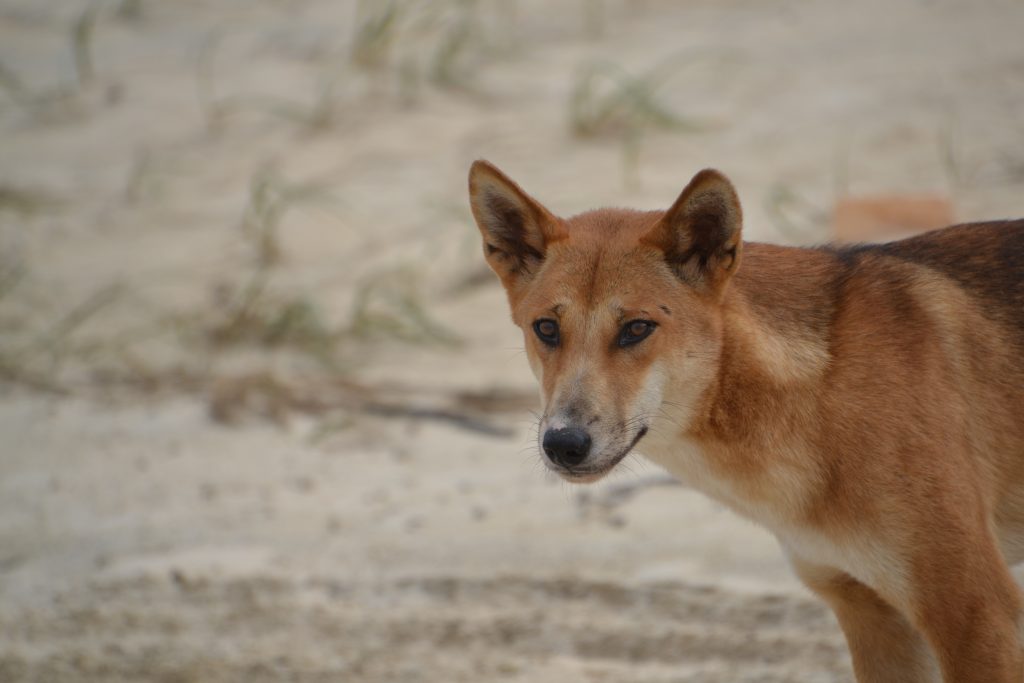
- Dingoes: They look like dogs, but they are wild animals.
- Wildlife: Don’t feed or approach them—respect their space.
- Isolation: Mobile service is limited, and recovery can be expensive.
Why is it dangerous to swim in the surf at K'gari?
K’gari’s stunning eastern shoreline may look inviting, but the ocean here isn’t your average day at the beach. Here’s why seasoned travelers and locals alike avoid swimming in the surf:
Powerful Rips and Currents
The waves on the eastern side are rough and relentless. Strong rips and undercurrents make swimming incredibly risky—even for confident swimmers.No Lifeguards
Most of K’gari’s ocean beaches are unpatrolled. If you get into trouble, there’s no one around to help.Sharks
The waters around K’gari are home to several species of sharks, including bull sharks and tiger sharks. Combine that with the fishing activity off the beach, and it’s just not worth the risk.Stingers
During the warmer months (especially October to May), Irukandji jellyfish and other stingers can be present in the water.
Where can you swim safely?
Thankfully, K’gari has plenty of safe, freshwater lakes like Lake McKenzie, Lake Wabby, and Eli Creek for a cooling dip. You can also enjoy the Champagne Pools—natural rock pools near Indian Head that are protected from ocean waves and perfect for a refreshing soak.
How do I stay safe from dingoes?
Dingoes It’s important to be dingo safe on K’gari as dingoes have been known to attack people. By following these tips you can limit negative encounters:
- Never feed dingoes – a good rule for any wild animal. It’s actually an offence to do so and you will be fined.
- Walk in groups and carry a stick. When we were at the main areas on K’gari, dingo sticks (a rubber stick) were available to carry.
- Keep children close – Never let children walk around holding food.
- Don’t leave rubbish around – Always take your rubbish with you.
- Don’t run if dingoes are around as it stimulates their chasing instinct. If one comes close, stay calm, stand tall and maintain eye contact. If you are with someone, stand back to back. Call for help.
We didn’t have any issues with dingoes whilst we were on K’gari as we followed these rules.
To learn more about how to be dingo safe, visit this link.
Why did K'gari change its name from Fraser Island?
The name K’gari (pronounced “Gurri”) means “paradise” in the language of the Butchulla people, the Traditional Owners of the island.
For more than 60,000 years, the Butchulla people lived on the island, caring for its land, lakes, and sea. In their Dreamtime stories, a spirit named K’gari helped create the world and was so enchanted by her work that she stayed behind and became the island itself.
For many years, the island was known as Fraser Island, named after Eliza Fraser, a shipwreck survivor whose controversial account of her time with the Butchulla people led to devastating consequences for the community.
In 2021, after years of campaigning by Butchulla Elders and cultural leaders, the island’s original name was officially restored to K’gari. It was a powerful moment of recognition and respect for the island’s Indigenous history and significance.
Why does K'gari deserve a place on your bucket list?
If you’re after an adventure that blends natural wonder with adventures, K’gari delivers on every level – we loved every moment. It was so much fun.
Here’s why it’s a bucket list must:
-
It’s wild—not polished, not packaged, but raw and real.
-
You can drive along the beach, hike to hidden lakes, and watch the stars from your camp.
-
It’s one of the few places in the world where nature feels untouched.
Whether you’re 25 or 75, if you crave a little adventure, a lot of nature, and to disconnect from the rest of the world, K’gari is waiting for you